

『Flow Meter Gas: Comparing Thermal Mass and Vortex Sensors』Related information(flow rotameter|digital flow meter|balo meter|hydraulic flow meter|volumetric meter|positive displacement meter|pitot tube flow meter|displacement meter|cfm meter|variable area flow meter|inline flow meter|differential pressure flow meter|calibrated flow meter|velocity meter|paddle wheel flow meter|oval gear flow meter|anemometer hvac|multiphase flow meter|doppler flow meter|thorpe tube flowmeter|heat flow meter)
Thermal Mass vs. Vortex Gas Flow Meters: Which One Fits Your Application?
Quick Answer: For dry, clean gases like compressed air, nitrogen, or natural gas, a thermal mass flow meter delivers direct mass flow readings without extra sensors. A vortex flow meter handles steam, wet gases, and higher temperatures, and it often costs less for larger pipe sizes. Your choice comes down to gas condition, required accuracy, maintenance tolerance, and budget.
How Thermal Mass Flow Meters Work in the Real World
Thermal mass meters use the principle of heat dissipation. Two PT100 sensors sit inside the gas stream. One sensor measures the gas temperature; the other is heated. As gas flows past the heated sensor, it cools it down. The meter measures how much energy it takes to keep that temperature difference constant. That energy correlates directly to mass flow. No external temperature or pressure compensation is needed. This is a big deal for custody transfer or plant air audits where you want kg/h or standard cubic meters per hour right on the display.
How Vortex Flow Meters Handle Gas Measurement
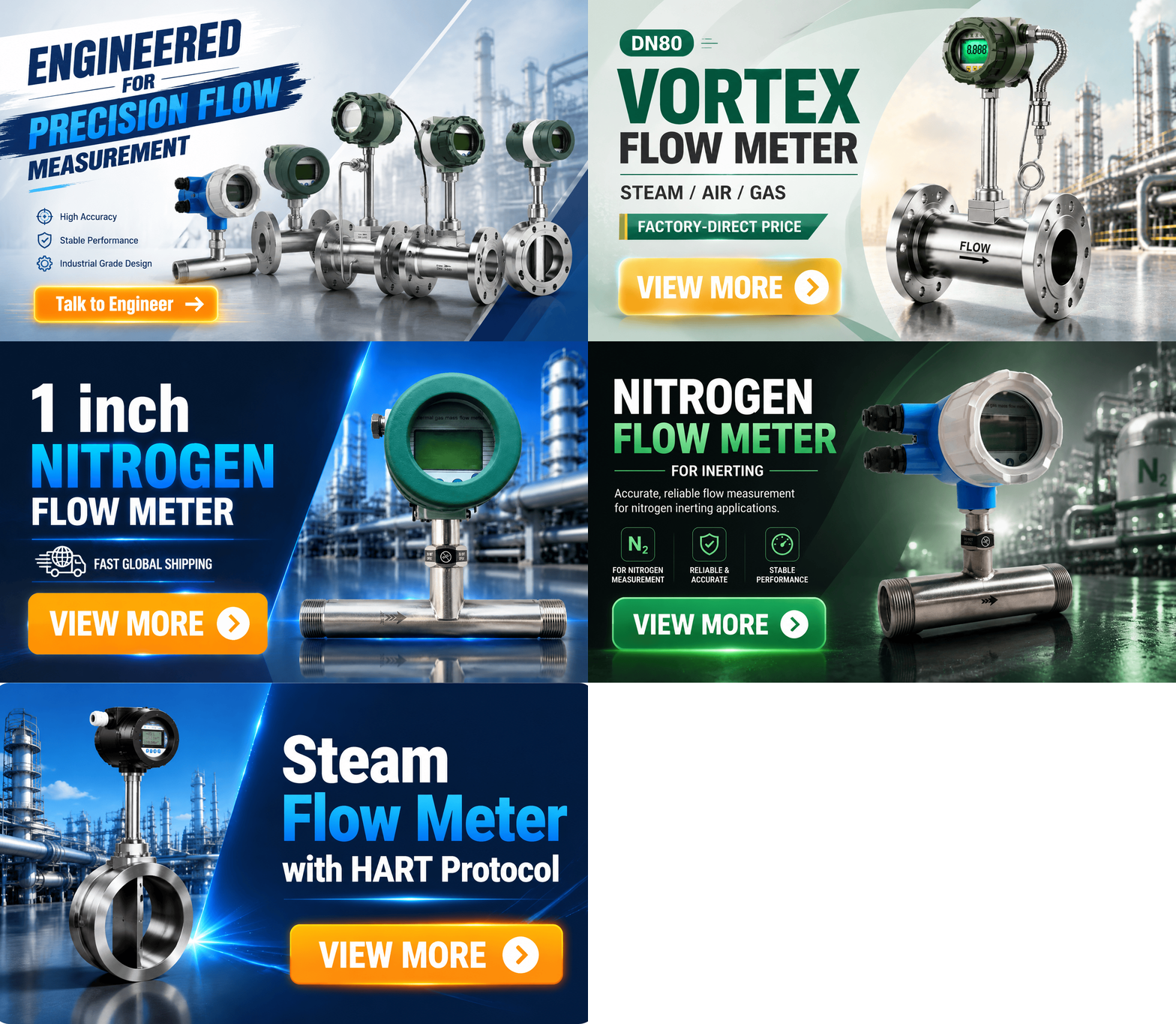
A vortex meter places a bluff body in the flow path. As gas passes it, vortices shed alternately from each side. A piezoelectric sensor counts the vortex frequency. That frequency is proportional to volumetric flow velocity. But here is the catch: raw vortex output is actual cubic meters per hour. To get mass flow or standardized volume, you must add a pressure transmitter and a temperature sensor. Many modern vortex meters integrate these into the electronics, but you still pay for the hardware. The advantage is that vortex meters work with steam, flue gas, and biogas at temperatures up to 250 °C or more, where thermal meters would fail.
Where Thermal Mass Wins: The DN15 to DN50 Sweet Spot
We see thermal mass flow meters installed most often in small to mid-sized compressed air lines. A typical factory in Thailand might have a DN25 ring main feeding several production cells. Thermal insertion probes can go straight in via a ball valve and compression fitting. Accuracy of ±1.5% of reading is normal. Response is fast. No upstream straight pipe run of 30D is required, unlike a vortex meter that often needs 20D upstream and 5D downstream. If you measure compressed air from a screw compressor at 7 bar and 25 °C, a thermal meter like our SIL-TMF series gives you kg/h or scfm instantly.
Where Vortex Makes More Sense: Steam and Wet or Dirty Gas
Steam applications need vortex technology. Saturated steam at 10 bar and 184 °C would destroy a thermal sensor within days. Vortex meters with integrated temperature and pressure compensation output mass flow of steam directly. We have supplied SIL-VF vortex flow meters to a palm oil refinery in Indonesia measuring steam to the deodorizer. Pipe size was DN80. The meter runs 24/7 with minimal drift. Condensate can be an issue, but a properly installed meter with a steam trap upstream manages it. Another place vortex shines is biogas measurement. Biogas is wet, contains hydrogen sulfide, and can vary in composition. Thermal meters struggle because thermal conductivity of biogas shifts with methane content. Vortex plus a pressure transducer gives reliable volumetric flow, and you apply a fixed gas density factor or an online gas analyser to estimate mass flow.
Practical Installation Details Engineers Skip
Most engineers skip checking the minimum flow turndown. Thermal mass meters for gas can turn down 100:1 or more. Vortex meters usually give 20:1 or 30:1 turndown. If your night shift runs at 10% of peak flow, a vortex meter may stop registering. We have seen this on a customer site in Vietnam. They bought a vortex meter for a nitrogen blanketing line, but at low purge rates the meter output dropped to zero. They replaced it with a thermal mass flow meter and solved the proble
Cost and Long-Term Ownership
For a DN50 gas line, a thermal mass flow meter from Silver Automation Instruments costs roughly from 650 to 950 USD, depending on communication options like 4-20 mA HART or Modbus RTU. A comparable vortex meter with integrated pressure and temperature runs 800 to 1200 USD. The thermal meter has no moving parts and rarely needs recalibration if the gas is clean. Vortex meters can suffer from piezoelectric sensor drift over 5 years. However, vortex excels in high-temperature applications where thermal is nonviable. Maintenance teams appreciate that a vortex meter can be replaced without cutting the pipe; thermal insertion probes also offer hot-tap installation, but inline spool-piece thermal meters require a process shutdown.
When to Use Each: A Real-World Selection Table
Compressed air audit in a food plant: thermal mass insertion probe, no extra sensors needed. Nitrogen purging in a chemical reactor: thermal mass, direct mass flow, high turndown at low flows. Saturated steam to heat exchangers: vortex with built-in compensation. Flare gas in a refinery: vortex with alloy bluff body and high-temperature sensor. Biogas to a boiler: vortex is easier to clean if H2S fouling occurs. Natural gas custody transfer: thermal mass with ATEX Zone 1 certification is accepted in many small and medium trading applications; for large pipelines vortex with a flow computer is more common.
Five Questions Engineers Often Ask Us
Can a thermal mass flow meter measure gas flow with oil mist?
No. Oil mist coats the sensor beads and changes heat transfer characteristics. Use a vortex meter with a coalescing filter upstream, or switch to a Coriolis meter if direct mass flow is needed.
Does a vortex meter need straight pipe run for gas?
Yes. Typically 20 pipe diameters upstream and 5 downstream. If you have space constraints, a thermal mass insertion probe can often be installed with only 10D upstream.
What about mixed gases with changing composition?
Thermal meters are sensitive to thermal conductivity shifts. If your gas mixture varies more than 5%, a vortex meter with an online gas chromatograph and flow computer yields better accuracy.
Can both meter types measure bidirectionally?
Vortex meters often measure bidirectional flow with reduced accuracy. Thermal mass flow meters are typically unidirectional unless a special dual-sensor probe is used.
What is the typical lead time for a DN40 vortex flow meter with HART?
Silver Instruments stocks many models. A standard SIL-VF with integral temperature compensation and 4-20 mA HART output ships within 5 working days from our Nanjing factory.
Recommended Models and How to Get a Quote
For compressed air and inert gases, our SIL-TMF thermal mass flow meter handles pipe sizes from DN15 to DN1000 using inline or insertion styles. Output options include 4-20 mA, pulse, RS485 Modbus, and HART. Accuracy is ±1.5% of reading. For steam and corrosive gases, the SIL-VF vortex flow meter covers DN15 to DN300 with Hastelloy or 316L bluff bodies. It supports integrated temperature and pressure compensation, ATEX Zone 1 certifications, and remote electronics. Both series are in stock for fast delivery to Southeast Asia, the Middle East, and South America.
Send us your gas type, pressure (bar), temperature (°C), pipe size (DN), and flow range. Our engineers size the meter and return a datasheet the same day. Email [email protected], call +86-135-1213-1526, or message us on WhatsApp at 86-135-12131526. WeChat users can reach us at +86 13512131526. Visit flow-meter.com.au for full specifications and manuals.
 Hot Blog
 Related AD